
· ARUM Team · Installation
Neon Flex 220V Troubleshooting — How to Fix the Most Common Problems
Step-by-step guide to diagnosing and fixing the most common Neon Flex 220V problems — strip not lighting, flickering, sections going dark, and how to prevent them.
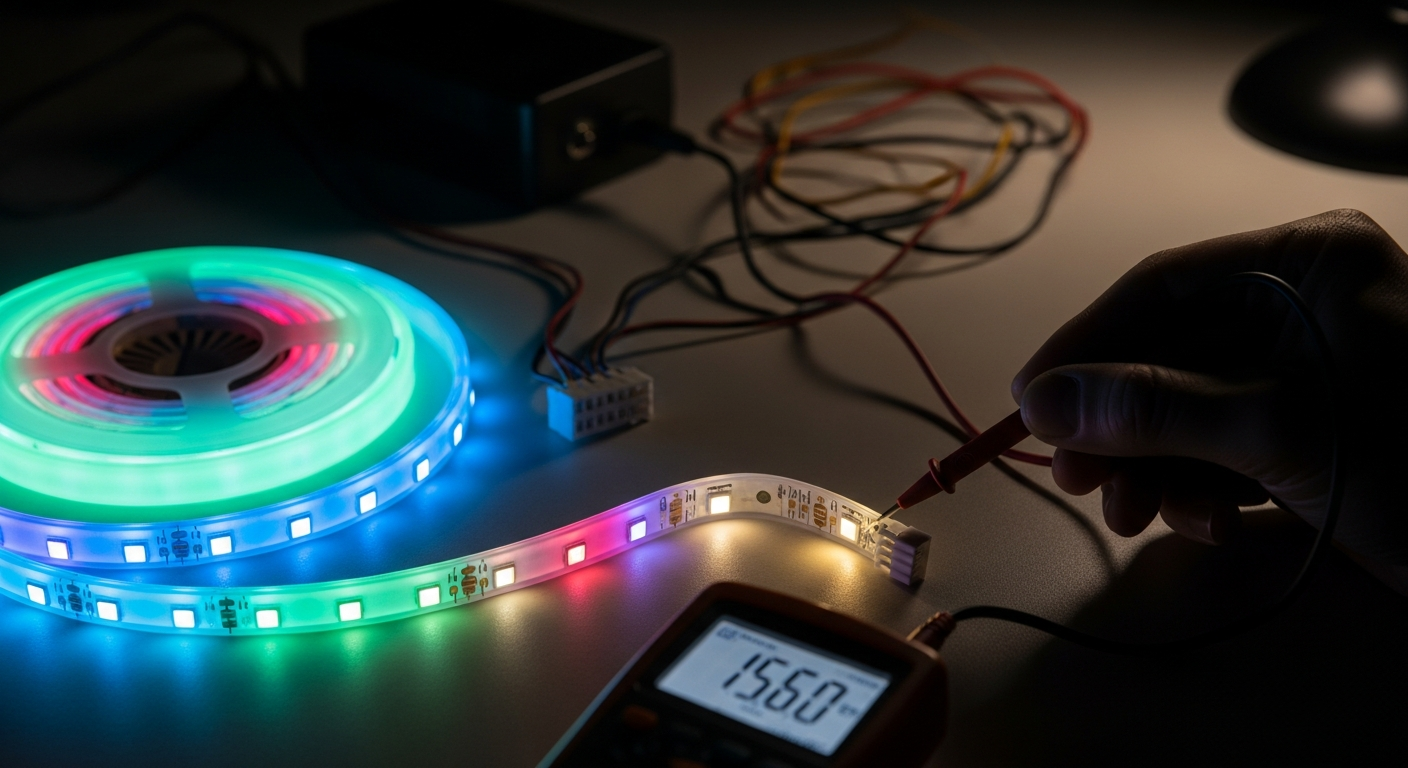
Common Causes of Neon Flex 220V Problems
Neon Flex 220V operates on household voltage via a built-in rectifier, which makes it convenient — but it also has failure modes specific to its design. Most problems trace back to three root causes: incorrect connection, cutting outside the designated intervals, and moisture entering connectors.
Neon Flex 220V has cut points every 50cm or 100cm depending on the model. Cutting between these marks will cause a segment to go dark permanently or create a short circuit. Loose connections and incorrect polarity are also common causes, especially in outdoor installations where vibration and weather stress connections over time.
How to Diagnose the Problem
Step 1: Check the connectors Inspect every connection point for loose wires, burn marks, or burning smell. If any connector shows heat damage, replace it immediately.
Step 2: Check cut points If a section of the flex has gone dark, examine whether the cut was made precisely at the marked interval. If it was cut between marks, that section cannot be repaired and must be replaced.
Step 3: Check for moisture For outdoor installations, inspect connectors and end caps for water ingress. Moisture at connector points is the primary cause of flickering or darkness in outdoor Neon Flex. Look for water inside the silicone tube itself.
How to Fix Each Problem
If the entire strip doesn’t light up:
- Check the wall switch and circuit breaker
- Try plugging directly into a working outlet to eliminate the circuit as a variable
- If still no response, the LEDs inside the tube may have failed — replacement is typically the solution
If the strip flickers:
- Check and re-seat all connectors; tighten if loose
- If only a section flickers, those LEDs are degrading — expect the section to fail soon
- If the entire strip flickers, it may be unstable mains voltage — a voltage stabilizer may help
If sections have gone permanently dark:
- Check whether those sections were cut at the correct marked interval — wrong-cut sections can’t be repaired
- Trace the run physically by hand to find any point where the strip may have kinked or been physically damaged
- If the dark section is at a connector joint, replace the connector
Prevention — Install Right the First Time
Correct installation is the most effective long-term fix:
- Always use end caps to seal both ends of the flex and prevent moisture and dust from entering
- Use waterproof connectors for all outdoor applications — standard connectors will corrode
- Respect the minimum bend radius in the product specifications; too tight a bend stresses the internal PCB and cracks solder joints
- Inspect outdoor installations every 6–12 months — UV exposure and rain degrade connectors faster than the strip itself
When to Replace Rather Than Repair
Consider replacing your Neon Flex when:
- Color has shifted significantly from original (yellowing, or uneven sections)
- Permanent dark spots that reappear after replacing connectors
- The same connector location keeps failing — more than once per year
- Installation age exceeds 3–5 years in outdoor conditions with heavy UV exposure
Summary
Neon Flex 220V is reliable when installed correctly. The vast majority of failures trace back to improper installation — cutting at the wrong point, loose connectors, or missing moisture protection. Fix the installation method and most Neon Flex problems resolve permanently.
Browse Neon Flex 220V and accessories at arumstores.com/neonflex.