· ARUM Team · LED Knowledge
LED Cove Molding — What It Is and What to Know Before You Buy
Understand what LED cove molding (bua son fai) is, how it works, the benefits it provides, and everything to prepare before purchasing for your home.
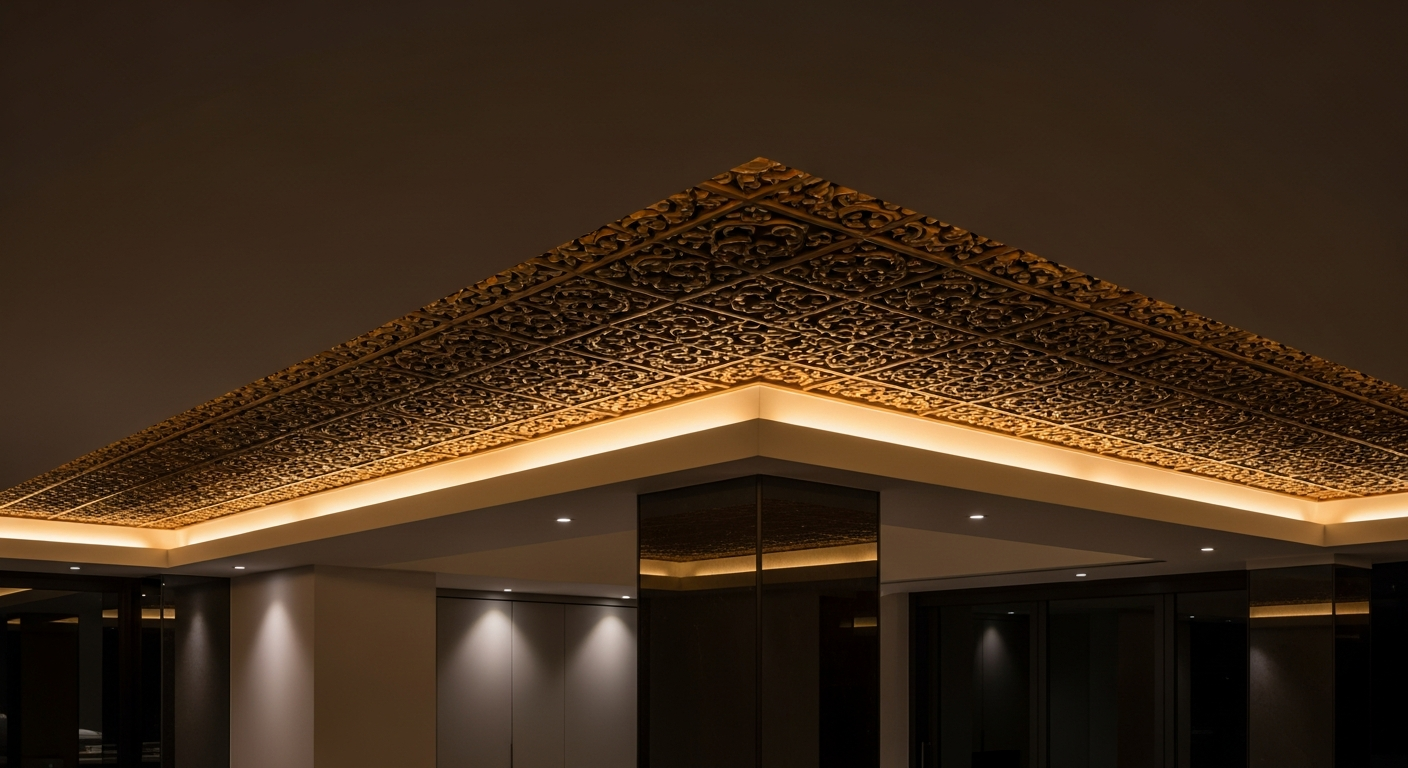
LED cove molding (cove lighting profile) is an installation technique that hides LED strips inside a decorative molding, allowing only the reflected light to be visible — not the source itself. It’s one of the most effective ways to instantly elevate the look of any room without expensive fixtures. This guide explains the structure, how it works, and what to know before purchasing.
What Is LED Cove Molding?
A cove molding profile is a shaped piece of PU (polyurethane), gypsum, or aluminum that mounts along ceiling edges, wall tops, or interior recesses. When an LED strip is inserted inside, light reflects off the ceiling or wall in a continuous, seamless band — with the strip itself completely hidden.
Key benefits of cove lighting:
- Soft, diffused light — no harsh direct glare like downlights
- Makes ceilings feel higher — upward-facing reflected light creates an illusion of 30–50cm more height
- Conceals wiring — cables run neatly inside the profile
- Adjustable atmosphere — using a CCT dimmer, shift from warm (2700K) to cool (6000K) with a remote
How the System Works
A complete LED cove lighting system has four components:
The Profile/Molding — the outer housing that conceals the strip and reflects light. Choose the profile shape based on your desired light output: Curve for soft diffused light, Edge for a sharper defined line, Recessed for a fully flush built-in look.
LED Strip — typically COB 24V at 320–480 chips/m, or SMD 2835 at 120–240 LEDs/m, for smooth, even output
Power Supply — 24V DC transformer sized appropriately for the total run
Dimmer/Controller (optional) — for adjusting brightness or color temperature
When powered, the LED strip inside the profile illuminates and the light reflects off the ceiling or wall as a continuous band. The profile edge blocks direct view of the light source, so you only see the soft, even glow.
Benefits You Get
LED cove molding delivers results that other lighting types can’t:
- Luxurious atmosphere — ideal for contemporary and minimalist bedroom and living room designs
- Energy efficiency — a COB LED strip at 10W/m consumes 30–50% less energy than equivalent downlights for the volume of light produced
- Long lifespan — 30,000–50,000 hours means install once and use for 10+ years
- Reduced harsh shadows — reflected ceiling light distributes evenly throughout the room
- Mood control — with a CCT dimmer, shift from warm (2700K) in the evening to cool (6000K) during working hours
What to Prepare Before Buying
Get these details sorted before you order:
1. Measure the full perimeter of the installation area — include all corners; add 10% for cutting waste
2. Calculate required power — e.g., COB 10W/m × 20m = 200W; choose a PSU rated for at least 250W
3. Choose your color temperature — 2700K (warm), 3000K (warm white, most popular), 4000K (neutral), 6000K (cool white). When in doubt, 3000K is the safe default.
4. Consider ceiling height — Ceilings below 2.5m: use a thinner profile so it doesn’t look heavy. Ceilings over 3m: larger profiles work well.
5. Check profile material — PU is lightweight and paintable. Aluminum offers the best heat dissipation. Gypsum blends seamlessly with plastered ceilings.
6. Distance from ceiling — For a smooth band of light, the strip should be 10–15cm below the ceiling. Too close and you’ll see individual hot spots instead of a clean line.
Beginner Tips
If this is your first cove lighting installation:
- Start with one room — try a single wall of the living room or bedroom before committing to the full perimeter
- Choose Arum Curve as a beginner profile — easiest to install, completely conceals the strip, and produces the smoothest light
- Invest in a quality PSU from the start — if the PSU fails after the ceiling is sealed, accessing it becomes very difficult
- Test before sealing — run the full system for 30 minutes with everything exposed. Verify every section lights evenly before closing the ceiling.
- Photograph your installation — capture the PSU and cable positions before covering them, so you have a reference map for future maintenance
Arum offers three core profile types: Arum Curve (smooth curved profile for soft light), Arum Edge (sharp linear profile for defined light), and Arum Recessed (flush-to-ceiling for a fully invisible installation). All are available with matching COB LED strips and PSUs.
Summary
LED cove molding is far more than decoration — it transforms the entire atmosphere of a room for a fraction of the cost of other premium lighting approaches. With proper planning and quality components, you’ll have a system that performs beautifully for over a decade.
Interested in a complete cove lighting system? Contact Arumstores for sizing guidance and component recommendations.