
· ARUM Team · LED Knowledge
Complete Guide to COB LED Strips — Everything You Need to Know Before Buying
The definitive COB LED guide — types, specs, how to choose, installation, and maintenance. For homeowners and professional installers alike.
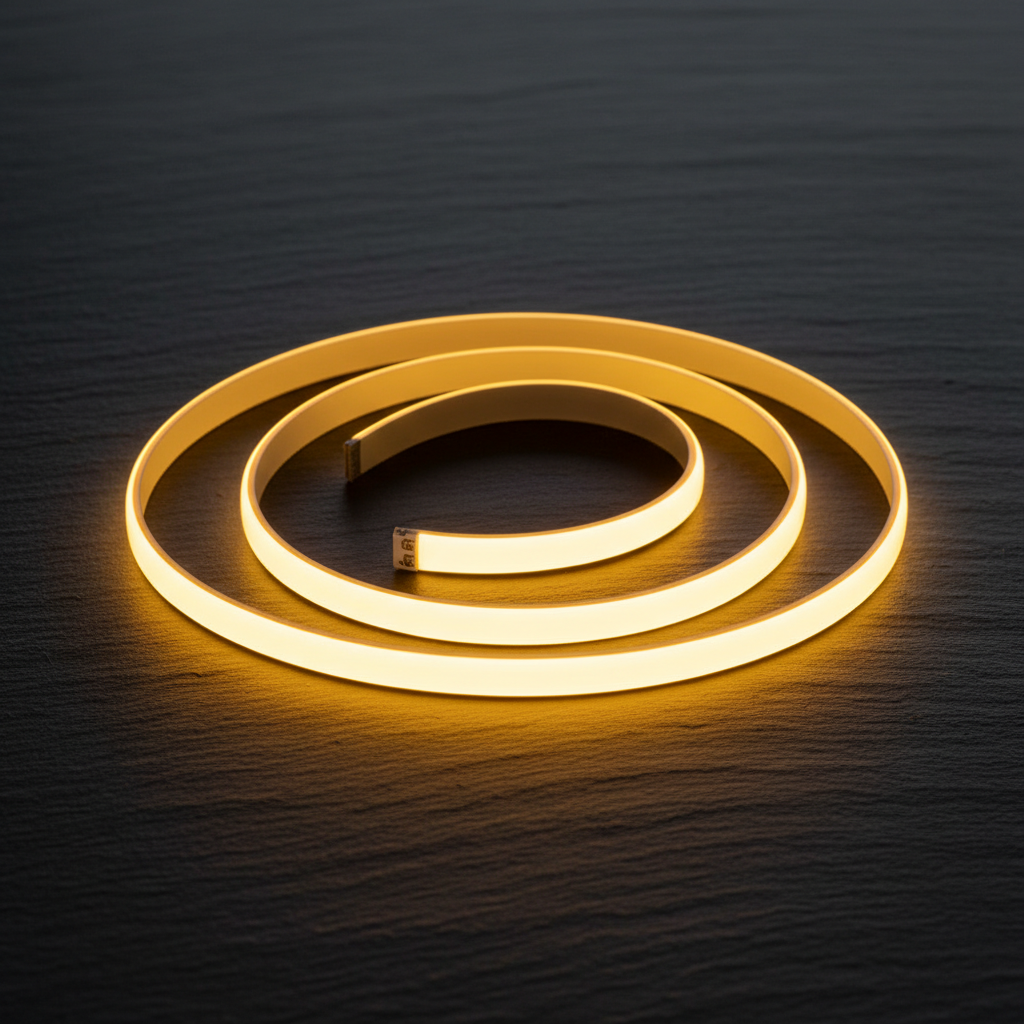
COB (Chip On Board) LED has become the new standard for premium ambient lighting over the last few years. It delivers smooth, continuous light that standard SMD strips simply can’t match. This guide covers everything you need to know before choosing and installing COB LED strips.
The Basics
COB = Chip On Board — a manufacturing method where hundreds of tiny LED chips (320–512 per meter in strip form) are bonded directly to a copper PCB and then sealed under a yellow phosphor layer.
The result: light that appears as a continuous line with no visible individual LEDs. No diffuser needed to achieve a smooth look.
Key Specifications
- Chip density: 320, 480, 512, 528 chips/m
- Voltage: 12V or 24V DC (24V preferred)
- Wattage: 8–20 W/m (varies by brightness and chip density)
- Brightness: 1,800–4,000 lm/m
- Color temperature (CCT): 2700K (warm), 3000K, 4000K, 6000K (cool)
- CRI: 80, 90, or 95 (higher is better; 90+ for premium applications)
- Beam angle: 180°
- Cut increment: every 1–2.5 cm
- Rated lifespan (L70): 30,000–50,000 hours
Types and Variants
By Chip Density
- 320 chips/m — standard quality, best value, excellent for most applications
- 480 chips/m — mid-to-premium, used in cove lighting and premium installations
- 512 chips/m — highest density, smoothest light, for professional installations
By Wattage
- 8 W/m — subtle backlight (TV backlights, under furniture)
- 12 W/m — general cove lighting
- 15–20 W/m — task lighting, under-cabinet kitchen use
By Color
- Single Color — fixed white in warm, neutral, or cool temperature
- CCT Tunable — adjustable from 2700K to 6000K via controller
- COB RGB — 16 million color options
- COB RGBW / RGBCCT — color plus white in one strip
By IP Rating
- IP20 — indoor only, no moisture exposure
- IP65 — bathrooms and kitchens with steam
- IP67 — outdoor, temporary submersion
- IP68 — permanent submersion (pools, fountains)
How to Choose: 7-Step Decision Process
Step 1: Where is it going? — Indoor/bathroom/outdoor → determines IP rating
Step 2: Choose voltage — Runs over 5m: use 24V. Shorter runs: 12V works
Step 3: Color temperature — Bedroom/living room: 2700–3000K, Kitchen/office: 4000K, Under-cabinet task: 5000K
Step 4: Chip density based on viewing distance — Viewed from >50cm: 320 chip/m looks perfectly smooth. Closer than that: 480+
Step 5: Calculate power — Length × W/m × 1.25 = minimum PSU wattage
Step 6: Choose CRI — ≥90 for color-sensitive applications (product display, makeup, photography)
Step 7: Confirm warranty — Minimum 2 years for reliable product
Warning Signs of Low-Quality COB
- Price significantly below market (< ฿200/m for 320 chip/m)
- Uneven phosphor — visible color spots along the strip
- Thin copper PCB (< 2 oz) — high trace resistance causes voltage drop
- No model number or datasheet available
- Strong adhesive smell from backing
Installation
Core process:
- Measure and plan — map the run, mark power injection points
- Prepare channels — cut aluminum channels to required length
- Cut strip at marked cut lines — scissors symbol only, never between marks
- Peel 3M backing — press into channel firmly
- Connect wiring — solder or use solderless clips; match + and −
- Connect to PSU — verify polarity before power on
- Test — run for 30 minutes, check temperature and uniformity
- Close covers and install permanently
Critical Installation Rules
- Must use aluminum channel — COB runs significantly hotter than SMD; without a channel, lifespan drops drastically
- Never run a single segment longer than 5m — voltage drop causes visible dimming
- Never bend tighter than 10cm radius — PCB damage risk
- Never power on with exposed live wires — short circuit risk
Maintenance
COB LED is easier to care for than most people expect:
- Dust every 3–6 months with a dry cloth (if channel is accessible)
- No acetone-based cleaners — will degrade the phosphor layer
- Don’t touch the chip surface with bare hands — skin oils cause localized discoloration
- Annual temperature check — if the channel exceeds 55°C during operation, inspect the thermal management
- Replace entire sections when they fail — COB individual chip repair is not practical
Summary
COB LED strips deliver premium-grade ambient lighting at a price that’s accessible to most homeowners. Match the specs to your application, install in aluminum channels, and use a quality PSU — and you’ll have a lighting system that performs for a decade.
Contact Arumstores for COB LED strips with full installation accessories. View all products.